Sailing Story
Overview
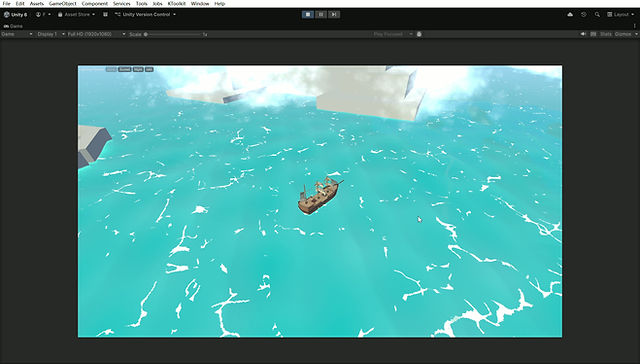
Sailing Story is a 3D simulation and resource-management game inspired by exploration-driven experiences like Stardew Valley.
Players navigate an open sea, manage resources, and complete delivery tasks while adapting to environmental conditions such as wind and weather. This game is still under development.
I worked as the Audio Designer, responsible for building a cohesive environmental audio system and supporting in-game immersion.
Responsibilities
Designed and organized in-game audio assets across core systems:
-
Boat movement
-
Ocean and environmental ambience
-
Weather effects
-
Port and interaction sounds
Structured audio assets for implementation in Unity using Wwise
Designed soundscape to support exploration and player immersion
Design Goals
The main goal was to support a relaxed yet dynamic exploration experience.
Key challenges:
-
Reflect changing environmental conditions (wind, storm, ocean state)
-
Support player navigation and movement feedback
-
Maintain a balance between immersion and clarity
-
Avoid repetitive ambience in an open-world setting
Audio Design
Boat & Movement
-
Sailing
-
Impact (collision with obstacles)
Ocean & Environment
Calm ocean


Calm Ocean Ambience serves as the foundational environmental layer for Sailing Story’s 2D soundscape, combining a continuous ocean ambience bed with a randomized wave system. The wave layer is implemented using a Sequence Container, which includes a Random Container of six distinct wave variations alongside a Silence layer. By carefully balancing the playback probability and timing between wave events and silence, the system maintains a cohesive ambience while reducing perceptual repetition, resulting in a more natural and dynamically evolving sound environment.
Rough ocean


Rough Ocean Ambience builds upon the structure of Calm Ocean Ambience, introducing more aggressive wave assets, increased dynamic intensity, and a different ocean ambience bed. Thunder and rain layers are added to enrich the soundscape, creating a heightened sense of tension and immersion. While retaining the same systemic framework, this variation delivers a distinct emotional shift and a more intense environmental experience.
Wind


The wind sound was designed and recorded in Reaper using the Kilohearts Phase Plant synthesizer, utilizing low-pass filtering and pitch control to create both gentle breeze and intense wind variations. For in-game implementation, Wwise’s Speaker Panning in Balance-Fade mode is used to control stereo positioning, enhancing the perception of wind direction and environmental movement.
Implementation
Boat Movement and Ambience
The implementation is built through the integration of Unity and Wwise, with a state-driven approach controlling audio behavior.
-
Boat movement is detected using linear and angular velocity from the Rigidbody, while a boolean state tracks the previous frame to trigger Play_Boat_Sailing_Slow and Stop_Boat_Sailing_Slow only on state transitions, preventing redundant event calls.
-
Environmental audio is driven by RTPC, where the boat’s speed is sampled every 0.1 seconds and mapped to the Ocean_Amb_Control parameter, allowing wave and sailing volume to respond dynamically.


-
Collision handling triggers Play_Boat_Impact, with additional camera shake applied when interacting with objects tagged as Obstacle, reinforcing audiovisual feedback.
-
Upon exiting the state, any active movement audio is stopped and the RTPC value is reset to zero to avoid audio carryover.